

When you work with complex mixtures, separating and identifying charged particles can feel like a challenge. Ion Chromatography offers a precise way to tackle this by using specialized columns and tailored solutions to isolate ions based on their unique characteristics. Understanding how this technique controls interactions and detects each component can change how you approach analysis—but there’s more to the process than just passing a sample through a column.
Ion Chromatography: Definition and Importance
Although it might seem complex at first, ion chromatography is a straightforward technique that separates ions based on their interactions with a resin.
You use it to identify and measure charged particles in a mix—like pollutants in water or nutrients in soil.
This method gives you precise, reliable results quickly https://laballiance.com.my/, so you’re not stuck guessing.
It’s essential in many fields, from environmental monitoring to pharmaceuticals, because it helps keep things safe and pure.
When you master ion chromatography, you gain the freedom to analyze complex samples efficiently, saving time and effort.
Understanding its definition and importance sets the stage for using this powerful tool effectively, giving you control over your analyses and confidence in your data.
How Ion Chromatography Separates Ions
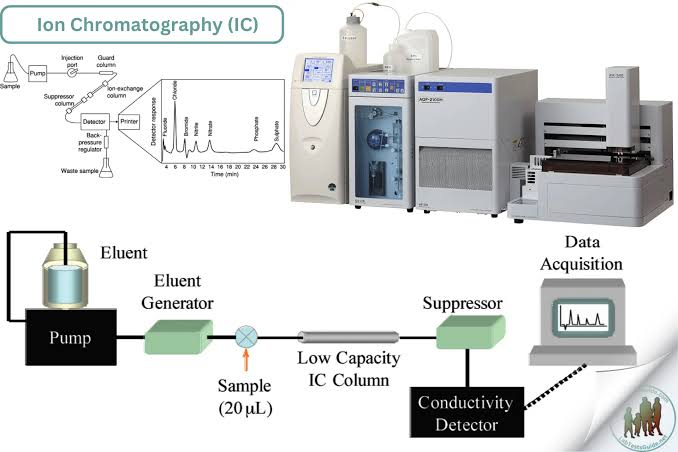
When ions pass through the chromatography column, they separate because they interact differently with the resin inside. You’ll find that some ions stick more tightly to the resin, while others move along faster. This difference in attraction depends on the ion’s charge, size, and affinity for the resin material.
As the liquid sample flows through, ions compete to bind with the resin sites, separating based on their unique interactions. You control the flow rate and composition of the mobile phase, which influences how quickly each ion elutes.
This process gives you the freedom to analyze complex mixtures by isolating individual ions effectively. Understanding these interactions lets you tailor conditions to achieve precise, reliable separation every time.
How Detectors Help Identify and Measure Ions
Once ions separate inside the column, you need a way to detect and measure them accurately. Detectors do just that by sensing ions as they exit the column. They convert the presence of ions into signals you can analyze.
Common detectors, like conductivity detectors, measure how well ions conduct electricity in the eluent. When ions pass through, they change the conductivity, letting you identify and quantify them. Other detectors, such as UV-visible or mass spectrometry, offer more specific detection based on ion properties.
Common Applications of Ion Chromatography
Ion chromatography plays a vital role in many industries by helping you analyze and monitor ions in various samples.
Whether you’re checking water quality, ensuring food safety, or monitoring environmental pollutants, ion chromatography gives you precise insights.
You can track contaminants in drinking water, detect additives in beverages, or assess soil health.
It’s also crucial in pharmaceuticals, where you verify the purity of drugs or identify impurities.
In industries like power plants and manufacturing, it helps you control process chemistry to prevent corrosion or scaling.
By using ion chromatography, you gain freedom to make informed decisions, improve safety, and comply with regulations efficiently.
This technique empowers you to maintain quality and protect health across diverse fields with confidence.
Tips for Accurate Results and Troubleshooting
Although ion chromatography is a powerful analytical tool, achieving accurate results requires careful attention to detail throughout the process. You’ll want to regularly calibrate your system with fresh standards to maintain precision. Keep your columns clean and replace them when performance drops, as contamination can skew your data. Monitor your eluent’s quality closely—impurities here can cause unexpected peaks.
If you notice inconsistent retention times or noisy baselines, check for leaks or air bubbles in your system. Don’t overlook sample preparation; filtering and diluting samples properly prevents clogging and matrix effects. When troubleshooting, systematically isolate each component to identify issues quickly.
Conclusion
Now that you understand how ion chromatography works, you can see how it efficiently separates and identifies ions using ion-exchange resins and specialized detectors. Remember, using clean columns, high-quality eluents, and proper calibration will help you get accurate, reliable results. Whether you’re analyzing environmental samples, food, or pharmaceuticals, this technique offers quick and precise ion measurement. With the right preparation and troubleshooting, you’ll confidently apply ion chromatography in your work.